

Everything is Housing
The four walls of Vermont public policy rest on a foundation of housing.

Let’s be honest: Vermont is expensive. Property taxes are rising, home prices continue to climb, and health care costs lead the nation. We face serious public policy challenges in our education system, our safety, our shrinking, aging population, and our vision for the future. Today, I argue that the most important policy problems facing Vermont are largely rooted in the same issue: housing. And in that case, they require similar solutions: more housing.
Catch up on the housing conversation from me:


And a recommended reading from Compass Vermont: Nation’s Fastest-Shrinking State: Vermont Loses 0.3% of Population Amid Aging Crisis and Housing Stagnation
And Seven Days: Vermont's School Enrollment Is Dropping at an Alarming Rate
Education
First and foremost, Vermont’s public education system relies on housing. Roughly 2/3 of the state’s collective budget for education is funded through property taxes each year - a higher share than in any other state (with the national average being 36%). While other states use different sources of revenue, like state sales or income tax, Vermont relies on property taxes to fund education in a way that most of the country doesn’t. I think it would be wise to look at new ways for the state to fund education, but for the sake of this article we’ll stick to the existing tax framework.
Education costs are rising, and thus, property taxes are too. One thing that isn’t rising? Population. Vermont is actually (and easily) the nation’s fastest-shrinking state.
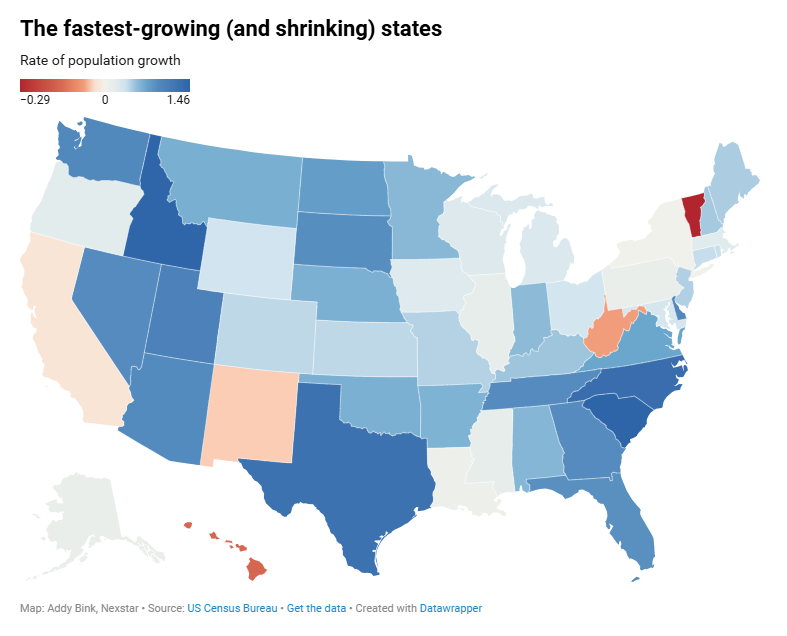
As we can all see, fewer people doesn’t equate to less costs. Think of the fixed costs in education - those that don’t change much when student enrollment does. Imagine a school in Vermont that sees declining enrollment year-to-year. The school pays for and maintains the same amount of property, heats the same square footage of the building, retains largely the same number of administrative staff (principals, office managers, janitors, etc), and so on regardless of the fact that fewer students are attending. Schools require a significant baseline funding to operate regardless of how many students are in the building. There may be fewer students attending a given school, but you can’t heat the building any less because of it.
Now take the variable costs - costs that closely follow student enrollment. Things like classroom supplies, graduation certificates, lunches, sports teams, and, for music class, recorders! Depending on the number of students in each grade, the school needs to provide a certain number of these variable items. There are fewer students at Hartland Elementary now than there were when I was a student there, so the school is likely saving money on its lunch bills - if we assume food costs have remained constant (which may actually be a poor assumption!)
There are some costs that in theory are variable, but in practice don’t change too much. For example, if a school loses students in theory, it will need fewer teachers to educate them. In practice, however, we see smaller class sizes with a similar number of instructors. Why? Otherwise, we would be leaving classrooms totally empty and unused. Also, students have become more labor-intensive to teach. The average student needs more support now than ever before (see COVID-19, increase need for special education, the opioid epidemic, oh, and that thing in your pocket…) The number of classroom teachers in Hartland hasn’t changed, but the amount of paraprofessionals/special education teachers/interventionists has skyrocketed to meet the rising demand. It’s well over half the staff, in fact.
As you may have parsed out, the expensive items are largely the fixed costs. The variable items that are most expensive (the staff positions, not the recorders) aren’t reflectively variable, either: they are actually increasing due to external forces even as enrollment declines. This is why per-pupil spending has grown so much.
I’ll touch on health care momentarily, which is a leading driver of the increase in the cost of education (and is entirely out of the control of local school boards). But I want to tie this back to housing. One way to reduce the property tax burden on individuals would be to spread it over more households. More property taxpayers would mean less property taxes per person. And, looking at the school costs that I’ve just laid out, adding students to our schools won’t impact fixed costs. I believe increasing the number of households in a town would have a net-positive effect on school costs. Marginal households contribute more to tax revenue than their children consume in schools because fixed costs are shared. We should share our costs amongst a wider pool of people, creating an educational economy of scale. Right now, we are sharing rising costs amongst a declining pool of people - not sustainable. But if we want more residents in Hartland and across the state (I argue we need them) we need places for them to live - housing is everything. Simply adding more homes doesn’t get at the root causes of cost increases directly. But indirectly, I think it does. I’ll explain further in the following sections.
Demographics
I read an interesting article recently from Compass Vermont’s Substack page (they do great reporting!) about VT’s demographic changes. They lay out a few startling statistics regarding the state’s population.
Every year since 2016, VT has experienced more deaths than births, resulting in natural population loss of 1,804 people between 2022-2023 and another 1,723 people in the year following.
The average age of Vermonters is 43.5, good for third oldest in the nation. And its increasing: Vermont is getting older.
Because of the discrepancy between births and deaths, which will widen as the state ages, Vermont needs almost 2,000 new residents each year “just to break even.”
Vermont ranks 50th out of 50 states in the share of residents aged 25-44 - prime working years. While the state’s unemployment rate is low, that statistic measures jobseekers’ ability to find work, not the amount of jobseekers or employers’ ability to fill vacancies. In short: unemployment is low because there aren’t enough workers.
As always, we live in two different Vermont’s in the Green Mountain State. Chittenden County has actually gained population since 2020 (it is always a statistical outlier in statewide data), while the rural corners of the state like Bennington County and the Kingdom have seen population declines more severe than reflected in the statewide average.
As I discussed in the last section, fewer taxpayers means either tax increases and/or loss of services for everyone else. But the problem is more complex than that. Taking into consideration the age statistics, fewer working-aged people results in a decline in income tax revenue (although an increase in estate taxes). But it also hampers the state’s economy when businesses can’t find help. You’ve seen the vacant downtown shops. Or maybe you are an employer who can’t find help and your business is stuck. These are businesses that could be employing people, providing needed services, and sponsoring little league teams. The downwind benefits of an ample workforce are strong; we just aren’t feeling them now.
Health care, while already in crisis mode, can expect further challenges as the state’s demographics change. Health care becomes more expensive and worse in quality when providers are short-staffed (or nonexistent in rural areas). Vermont currently has 79 unfilled primary care physician positions according to VTDigger. When people go without care, or don’t get the individualized attention they need from their overstretched doctors, they get sicker and more expensive to care for down the road. Aging people are naturally more expensive for the health care system to accommodate. To no fault of their own they simply need more medical care. Vermont’s risk pool is becoming top-heavy: comprised of more seniors who need more care and fewer young, healthy people who need less. For this reason, the state is expensive to treat but also to insure. And to circle back to education, the health insurance schools provide for their staff is becoming more expensive, fueling school budgets and subsequently property taxes. It’s all complexly intertwined, and it all comes down to housing.
The bottom line when talking about Vermont’s demographic challenges is that we need more people. When people leave or have fewer children in the aggregate the state gets more expensive to live in, encouraging more people to leave and discouraging those who stay from having kids. It’s a reinforcing cycle that we must break. But how can we expect people to stay in Vermont and start families, or move to VT with them, if we can’t provide them with housing? Young people are facing serious barriers to life planning. Consider the classic map: go to school, get a job, meet someone, get married, buy a house, start a family. Every step is arguably harder today than ever before due to unique economic and social hardships. The average first-time homebuyer in the U.S. is now 40 years old, an all-time high. Following the map is taking longer - getting to step five is becoming less common.
People are living longer, which is a good thing. It also means they are aging at home. Housing markets rely on fluidity: when the elderly pass or move into assisted living, their homes re-enter the market for the next generation to buy. When retirees look to downsize, their homes become available to the next young family to move into. In Vermont, new housing isn’t being built fast enough to stabilize the market (stop the bleeding, never mind attract new people). So the state relies heavily on this housing life cycle I have described. Problem is, it isn’t cycling: partly because people ae able to live at home longer, partly because of scarcity and high prices, and partly because of interest rates. You can sell your home for great money, but then where do you go? Economists call this phenomenon “golden handcuffs” and it creates a stagnating housing market, which in turn, encourages prospective homebuyers to leave or look elsewhere. Compass Vermont has another great article on this topic below.

We need to keep more working-age Vermonters in the state, and it wouldn’t hurt to bring in some new ones from elsewhere either. But we need places for them to live if we hope to address critical areas like health care or education spending. The demographic problem we face is compiling, and its roots lie in the lack of access to affordable housing. Solving for housing is solving for education, healthcare, and property taxes, along with public safety and democracy, the last two walls of my argument below.
Public safety
Between 2019 and 2023, the rate of homelessness in Vermont tripled. While COVID played a big role in this dramatic rise, Vermont today is still a state with a top-5 rate of homelessness. More people per 10,000 residents are homeless in Vermont than in California.
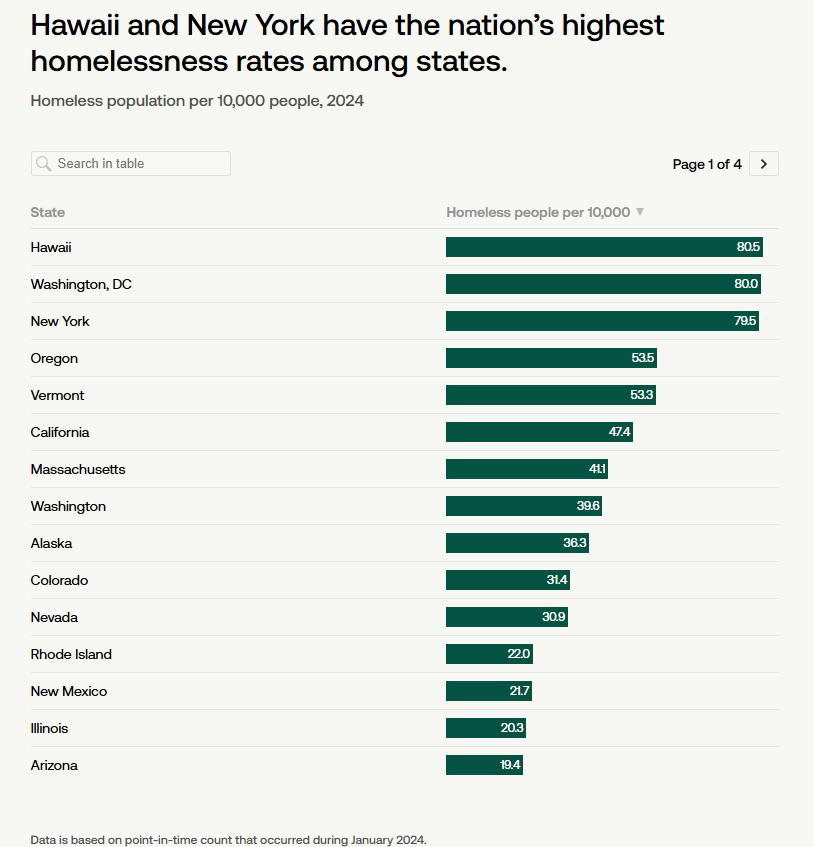
I don’t think I need to explain why homelessness is a housing problem. From a humanitarian perspective, everyone should be able to find stable housing. And from a public safety perspective, we shouldn’t have tent cities in our parks. It’s not a crime to be homeless, but it is criminal that our state is incapable of sheltering so many people. Especially in the winter. Especially in the world’s richest country. Getting people off the streets is good for us all, and it starts with building more housing and lowering housing costs. We need legitimately rentable places for Vermonters of all ages and incomes.
I noted earlier how the state has a workforce shortage, specifically in the health sector. The state is getting older but has fewer workers to take care of the elderly - bad combination. But the state also has a police shortage. Police departments north to south, from Burlington to Brandon to Bennington, are facing staff shortages. The Vermont State Police too is facing a shortage that has delayed a safety program for highway workers. VSP is integral in a state like Vermont, where many towns don’t have their own police departments. To enforce the law, police need housing too. There are more political reasons as to why we have a police shortage in VT that I’ll address elsewhere, but I’m sure cost-of-living and housing availability has a role to play here too.
Democracy
Housing is the backbone of the American Dream. The idea that anyone can become a homeowner is central to our faith in the economy, and therefore, our democracy. Right now, Vermont is failing to provide adequate housing. It and many other places in the country have failed to build the prosperous future we all hope for. And we are paying for it, financially and socially. The lack of attainable housing in Vermont has deepened the state’s affordability crisis. It has led to a more costly, stretched health care system, inflated property taxes, and sharply reduced our workforce and even our safety. The economic ladder for young and low-income Vermonters is being pulled up before they’ve had their chance to grab onto the rungs. It isn’t fair, but it is controllable.
We need to think of housing as a vehicle for democracy. If we take on the issue with the understanding that our economic and political order relies on it, we can reverse all the trends I have laid out today. A vicious cycle can become a virtuous one if we do so, and we’ll all be better off because of it.
When I talk to young people in and outside of Vermont, their biggest concerns tend to be financial. They tend to be about housing. We should listen to them. We should listen because we care about their wellbeing but also because we need them in our state. The fiscal health of Vermont will rely on its ability to attract/retain working age people. We can plan for a future without them, submitting to our failures of the past and present. Fewer schools in fewer towns, fewer shops on fewer main streets. Or we can imagine a more abundant future for ourselves, where we share our costs amongst a healthy community of workers, homeowners, and renters. Where our kids can plan their futures without forking over a third of their income to live on their own. Where town meeting day is an exciting opportunity to fund our town’s next generation of learners, not the last straw in a make-or-break decision to stay or to go.
Vermont has many policy problems on its hands. It is my belief that they start with housing. We need bold action to turn the tide of affordability in our favor. And we need leadership that is unwavering in its commitment to build a Vermont of tomorrow. A Vermont for everyone.
Dylan