


Scheduling the Airbnb had been easy. Ally and I made the 5-hour drive down to Salt Lake City for a long weekend to celebrate her birthday. Utah, a new state checked off the list! I had booked our studio online and received five or six emails throughout the week from our host in anticipation of our trip. But when we pulled into the parking lot, we were confused. None of the emails I had received pointed us in the right direction for how to enter. We walked around each side of the building, spoke with a woman inside, and checked the locked doors for entry. I returned to my inbox, found a phone number, and called our host.
The host wouldn’t pick up the phone. She texted me to let me know she doesn’t take phone calls. She said she also doesn’t text for “security” reasons, and that I must communicate with her through the Airbnb app. So I downloaded the app, signed in, and found that she had been sending me all the necessary information to check in to the studio through the app. We found our key in a lockbox on the fence, scanned into the property, and found our way to the apartment.
I’ll admit this is a luxury complaint, a “first-world-problem” if you will. And maybe I should have known I needed the app. But I didn’t, and after a long drive, this incident really frustrated me. I booked online, why should the host send me essential information through the app I didn’t have? Why couldn’t she take a phone call or text? Why does it seem like many of the modern innovations we’ve created to make life more convenient, like Airbnb, have actually made it less?
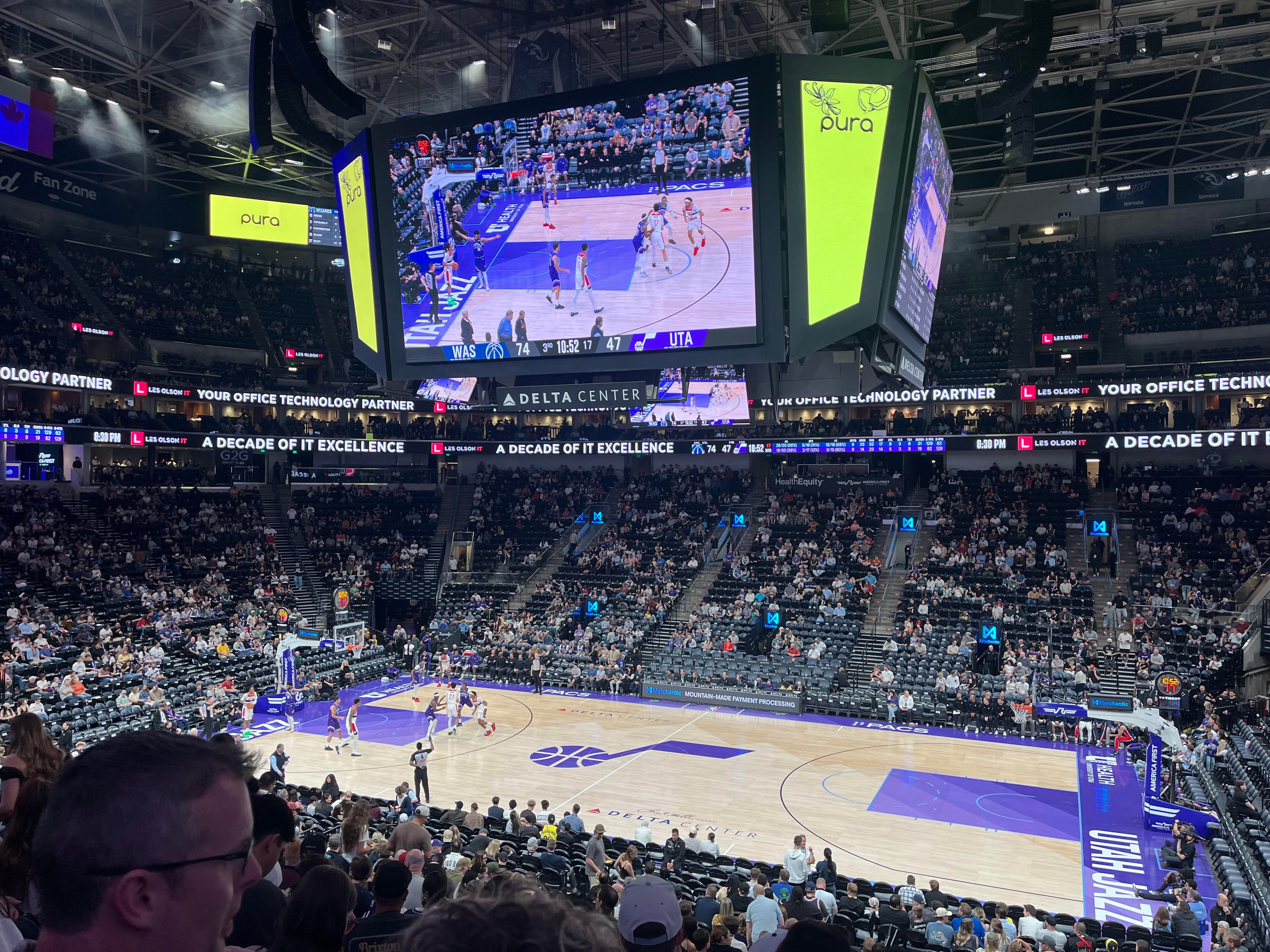
After we got settled in, we headed to our first event of the trip: an NBA game between the Utah Jazz and Washington Wizards. Now, I knew ahead of time that this wasn’t exactly going to be a premier matchup; both teams lie near the bottom of their respective conference’s standings and have been eliminated from playoff contention. But this is the NBA! The world’s premier basketball league would still put on a show. Both teams had in fact made trades since I bought the tickets to acquire better players: Trae Young and Anthony Davis for the Wizards and Jaren Jackson Jr. for the Jazz - all multi-time all-stars and a future hall of famer in Davis. While the teams weren’t very good, I was excited to see some of their premier players compete.
Just like when I pulled into the Airbnb parking lot, I was again confused when the starting lineups took the court. And again, disappointed. Four out of ten of the starters were players I recognized - remarkably low for a hoops junky like myself. In fact, I only had ever heard of five players who stepped on the court in Salt Lake City on that March evening. Box scored below:
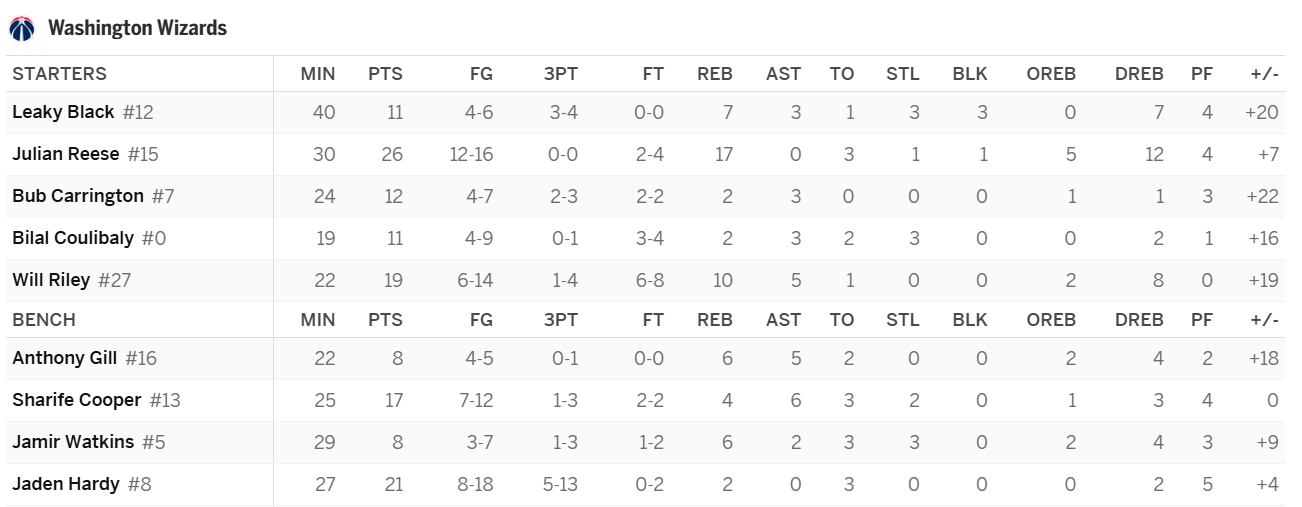
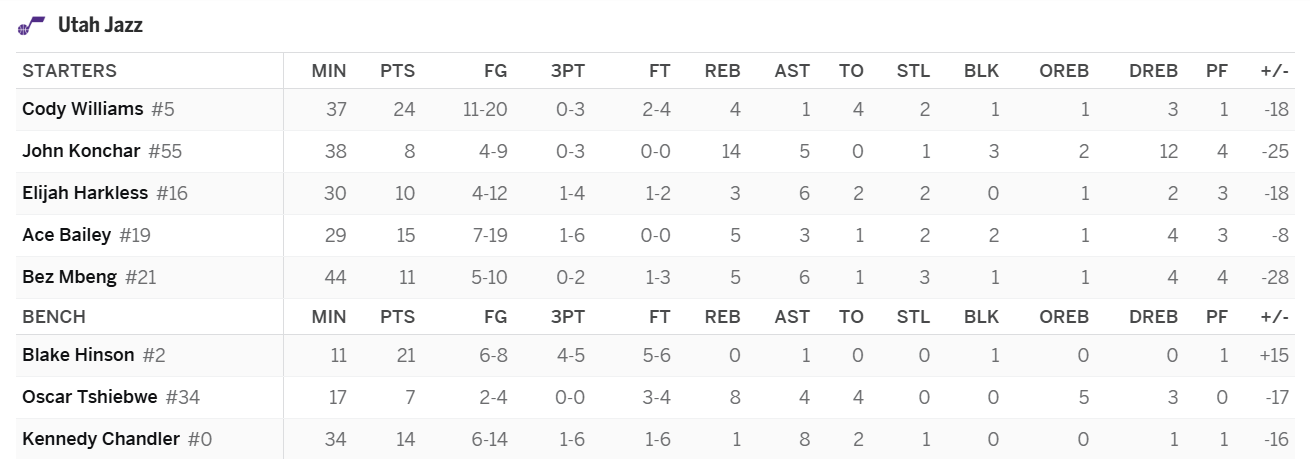
Many of these players are rookies, G-league or two-way players, undrafted or recently signed roster fillers. Where was Trae Young and AD? Jaren Jackson, Walker Kessler, Keyonte George? I saw Lauri Markkanen, the Jazz’s best player, relaxed in street clothes on the bench.
The result was predictable: a meaningless contest largely void of competitiveness. The players jogged up and down the court, knowing that the game they played in meant nothing to the teams they played for. A few uncontested yet still highlight-reel dunks from Ace Bailey were bright spots in an otherwise dim display of Naismith’s novel creation.
The NBA has a tanking problem. When teams know they won’t make the playoffs, they begin to intentionally lose games in hopes of acquiring a better draft pick for the following season. The Wizards and Jazz are both tanking, and have been for a while. The NBA uses a lottery system for determining draft order - the more losses a team accrues, the higher likelihood they get to choose first. Right now, the Jazz and Wizards are fifth and third, respectively, in the pursuit for the #1 pick.
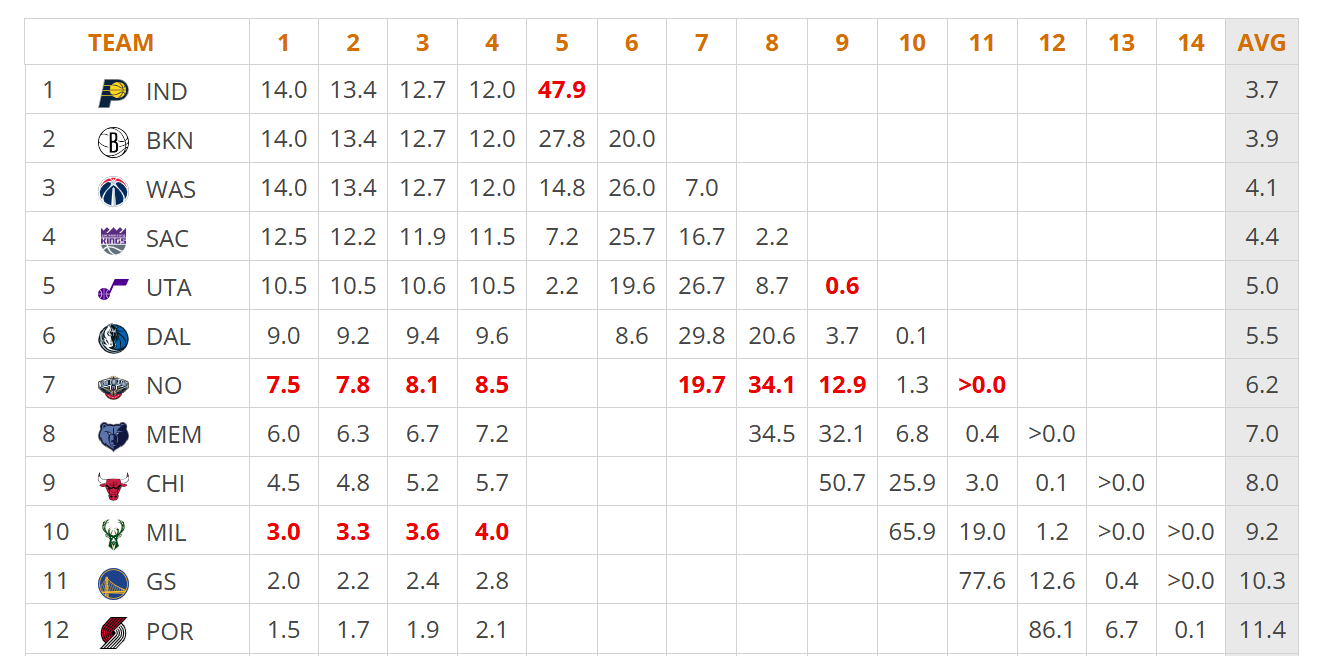
To further exemplify the problem, here’s a wild stat: as of March 23rd, the three worst teams (IND, BKN, WAS) had collectively lost 39 games in a row. Remember, these are professionals. Any NBA team can win any game on any given night. The NBA’s issue is that they are choosing not to.
Now, they can’t explicitly try to lose - there are rules against that. So the workaround is what Ally and I watched in SLC:
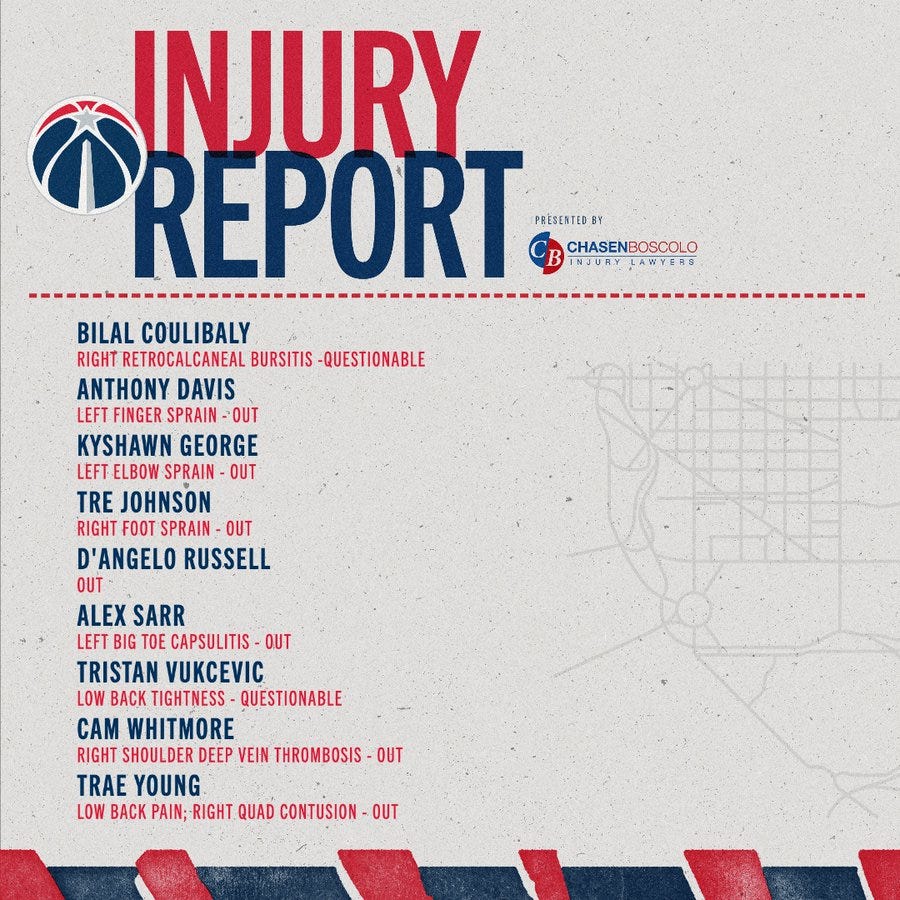

I don’t want to downplay any injuries, but come on guys. In all, 14 players were ruled out due to injury or illness, most of whom just so happen to be the best players the two teams could put on the court. Surely the teams will fire their training and medical teams for failing to keep so many players healthy, right? Wrong. This is by design. The Boston Celtics played the Oklahoma City Thunder recently, and only six players were ruled out. The Thunder ruled out five bench players (not stars) and the Celtics ruled out one - Nikola Vucevic - who I watched injure his thumb earlier this season. What is the difference between the two games? The Celtics and Thunder are both good teams competing for a championship - they have strong reason to field their best players, play hard, and put on a show. And they did. The Jazz and the Wizards, already eliminated, have strong reason to lose as often as possible while keeping their best players safe from (real) injury on the bench. Or, in Anthony Davis’s case, at home (he didn’t even travel with the team to Utah).
ESPN put out a great article last week summarizing the tanking problem in the NBA. They describe bad teams sitting good players in the fourth quarter of games, using analytics to find statistically poor lineups to play, even coaches drawing up plays that result in intentionally bad shots. Tanking has begun earlier in the season - a race for the bottom - featuring promising young players fouling out early and teams even manipulating player value by sitting quality role players in contract years in favor of lower-level talent to help the team lose. Tanking has real career implications for players, it jeopardizes competitiveness in the game, and hurts business for the league. Yet it persists.
I could go on and on about tanking, load management, ghost injuries, and competitiveness in the NBA, but I include this story to highlight the same frustration with the Airbnb: everything is broken. It isn’t working like it’s supposed to. And that just plain sucks.
One thing that did work? The self-checkout machine I used to buy a $2.00 bottle of water. It worked so well in fact that the machine asked if I would like to leave a tip when I paid.
Are you f**king kidding me?
I think Airbnb and the NBA are reflective of a bigger trend facing society. Things keep getting more accessible, more efficient, and… worse? It calls to mind a phrase coined by tech critic Cory Doctorow: Enshittification. It is used primarily to describe the theory that technology and tech platforms have declined in quality even as they have grown in use and popularity.
“Google Search had become enshittified, showing ads and product links instead of relevant website results. TikTok had become enshittified, artificially “heating” specific videos so that some would go viral, inspiring copycats and goosing engagement while frustrating creators whose output didn’t get the same treatment. Twitter would soon become royally enshittified in its reincarnation as X, losing its status as a global town square, as it tipped into Muskian extremism and rewarded grifters and meme accounts over legitimate news sources. Spotify, iPhones, Adobe software, e-mail inboxes—it was hard to think of a platform or device that wasn’t seeing a decay in user experience. Wasn’t technology supposed to endlessly improve in the long run?” - The New Yorker on Enshittification.
I can think of examples in my own life. I originally downloaded Instagram to follow the news. Now, I find myself swiping through seemingly endless “suggested” content to get back to the pages I actually chose to follow. I have a Facebook profile to keep up with friends and family, and to share my work - things that are meaningful to me. Why am I watching my seventh reel of random dudes building all-time NBA teams? No, gym bro from across the country, I don’t need to put protein powder in everything I consume. Please, enough with the advertisements!
I opened my phone to do one thing and have closed my apps after 15 minutes of absolutely wasted time. I’ve got nothing to show for it, so what is the point and why do I keep doing it?
The truth is, the internet is getting worse at delivering user-friendly experiences and results. In search engines, companies can pay a fee to have their products boosted to the top of the results, bypassing any sort of quality standards and matching determinations. Amazon can use its leverage as a massive seller to squeeze out smaller companies through price and compliance schemes. Websites are filled with ads, clickbait is everywhere, and now AI is further slopping up the internet. Netflix intentionally creates low-quality content to play in the background of your phone usage. Between one and two out of every ten X (Twitter) accounts is estimated to be a robot. Shortform videos on YouTube, Facebook, and really every platform out there now robs the time we could be using to cook good foods, read new books, or have meaningful conversations with the people around us. The loudest, most outlandish voices are exemplified to enrich shareholders of platforms like TikTok and Meta because in the equation where clicks = dollars, truth has no value.
This is not the internet we asked for - this much is clear. It isn’t nearly as helpful as it could be, and it’s probably doing more social harm than good for the average person. This isn’t the hospitality (Airbnb) or entertainment (NBA) we asked for, either. And this certainly isn’t the politics we’ve asked for. An increasing number of Americans now identify as Independents as the Republican and Democratic parties become more unpopular.
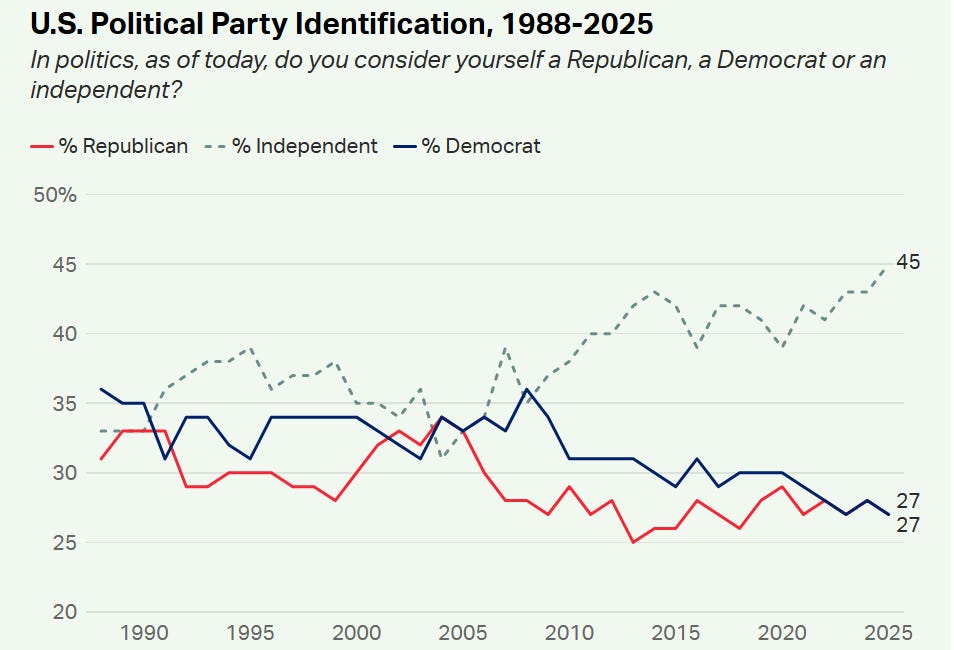
I don’t think the two are equate-able, but for the sake of bipartisanship I think most of us can agree that there are people out there more fit to be president than Donald Trump and Kamala Harris. Yet those were the nominees we got in 2024. I don’t think anyone believes Congress is working as it should, yet we continue to deal with a broken version of our nation’s most important legislative institution. Our politics, like our internet and our entertainment, is enshittified.
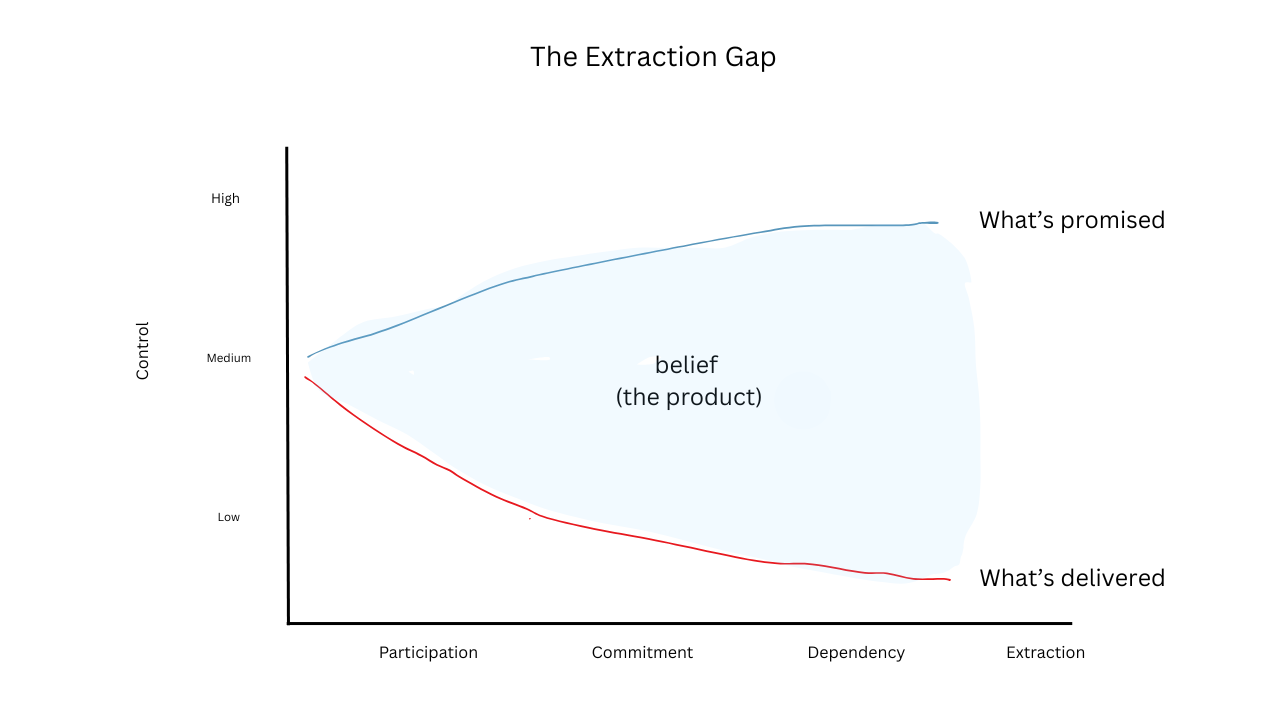
As Hannah Horvath puts into words better than I can in her article about “life admin” and the perils of modern adulthood:
“Technology promised to make life easier. But in many ways, it made individual tasks faster while multiplying them exponentially and scattering them across platforms that each demand a login you can’t remember.
The ‘mental load' captures this perfectly: anticipating needs, identifying options, deciding, monitoring — invisible labor that never completes because life’s demands are constant. It follows you everywhere. Modern adults make roughly 35,000 decisions daily, each drawing from finite cognitive resources. By evening, when that reservoir is empty, we default to what requires least effort: fast food, Netflix, scrolling.”
It doesn’t have to be this way, we just haven’t come up with a good solution yet. A good solution in my mind will take rules. I’ve been frustrated by some recent interviews, like this one from the New York Times with YouTube CEO Neal Mohan, that seem to seek moral or empathetic derivatives from platforms fueled by profit. We can’t expect YouTube or Meta or TikTok to act in our best interests if it cuts into their profit margins - that’s not how the business works. We can’t expect these platforms to police themselves like we can’t expect billionaires to tax themselves (talk about broken, check out our tax code!) We need rules.
We’ve been sold a series of lies by big tech and some of our other institutions, and because of it, things have gotten shittier. It’s easy to dive into conspiracy theories, but let’s focus on the truths right in front of us:
Social media promised connection, yet Americans are lonelier than ever.
We have numerous dating apps, yet people are dating less.
We have countless streaming services to watch anything we’d like, but we need seven subscriptions just to watch the seven things we really want to.
The internet has provided us with endless access to information at our fingertips, yet 70% of Americans fail basic civic literacy quizzes and we are further from consensus than ever.
We need rules. We can’t hope these issues solve themselves, that’s why I’m getting more and more excited to take them on. We need rules that fix our elections, as I have written about before. We need rules that protect our data from tech giants who sell it as a commodity to be profited from. We need rules that protect developing brains from harmful algorithms, like we protect them from marijuana, tobacco, and alcohol. We need rules that eliminate ultra processed ingredients from our food supply. We need rules that reclaim the internet - a universal resource - from the corporations who warp it for profit, to the people who use it for everyday good. The one we have now is no public square.
These are choices that government can make. In some cases, it makes the opposite choice or even plays on both sides. The American government subsidizes corn and soybean production that makes cheap, ultra processed foods, and then pays the bill for health care when the food system makes us sick. It subsidizes the oil industry and pays for disaster recovery (before Trump, at least) when hurricanes or flooding wrecks our communities. Government is the vehicle for creating and enforcing rules when things (like the internet, elections, tax codes, etc.) go awry. There’s no other arbiter. But in this moment, it is failing to make them, and people are noticing. It’s a big reason why trust in government is so low: it hasn’t proven itself capable of meeting the moment. It’s not the conspiracy theories that need addressing, it’s the real things right in front of us that are broken and need fixing. The things that are harming us all. The things that right now are just plain shitty.
On to my fifth attempt to schedule an eyecare appointment. Wish me luck!
Dylan